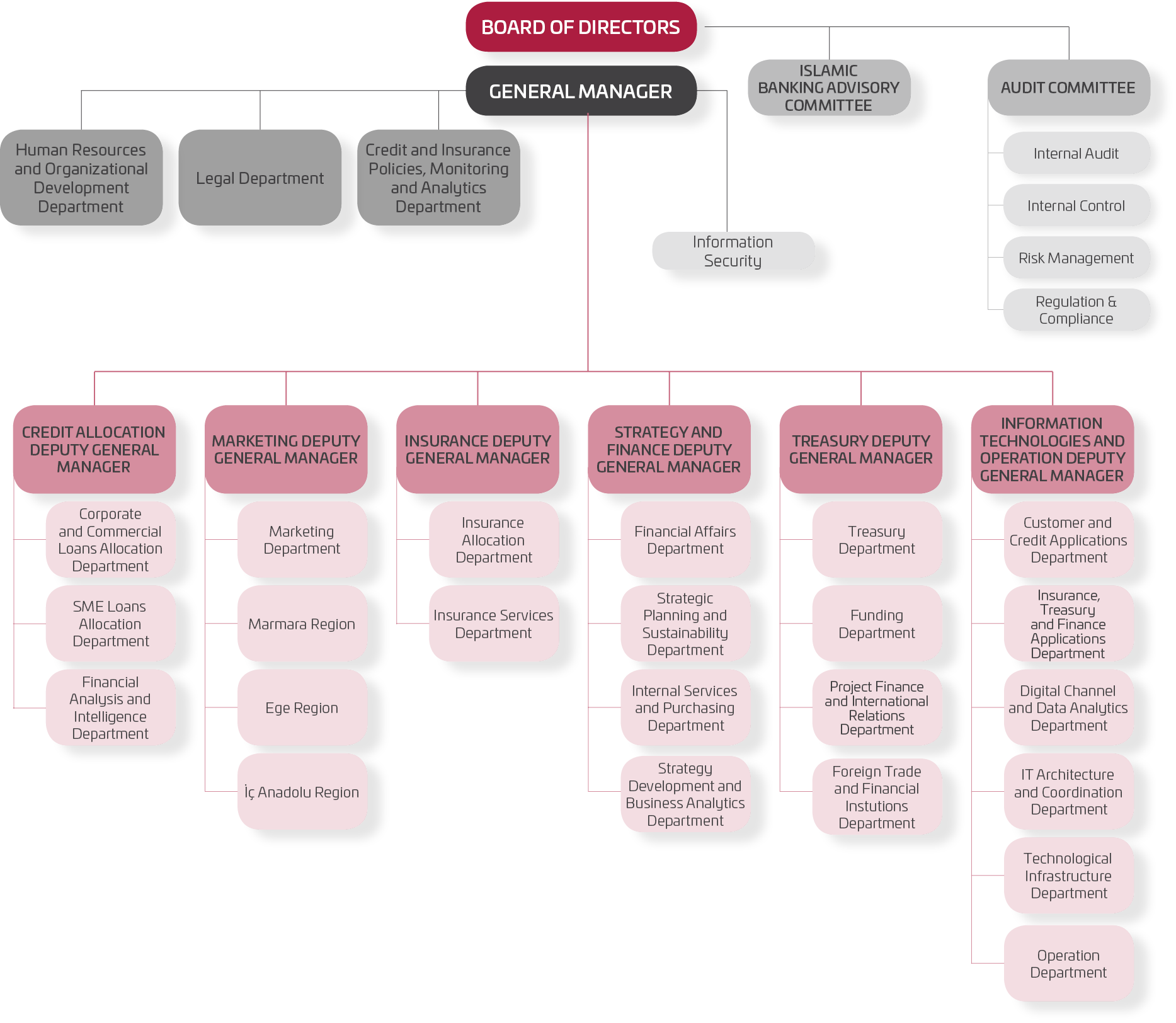
Organization Chart
Organizational Developments
In 2024, the following organizational changes took place at our Bank in line with the Bank’s goals and strategies:
- Organizational changes and new additions were made to our Information Technologies and Operation job family for increasing the efficiency of our Bank’s Information Technologies and Operation Units, clarifying the functional segregations in line with the needs of our Bank’s internal stakeholders, vesting their internal management in a more effective structure and transforming them into a structure that will better adopt to the developments and novelties in the banking industry. Accordingly, Customer and Credit Applications Directorate; Insurance, Treasury and Finance Applications Directorate, Digital Channel and Data Analytics Directorate, and IT Architecture and Coordination Directorate were set up, which also incorporate the tasks and affairs handled by the previous structure. Sections were established under these departments to accommodate changes and novelties stemming from the functional segregations and requirements mentioned above.
- Organizational changes and new additions were made to our Treasury job family for more efficient execution of the tasks and procedures at our Bank’s Treasury Units; faster fulfillment of our internal and external stakeholders’ needs and demands at a higher quality; building on our Bank’s correspondent relations as well as relations and dealings with financial institutions, and further broadening and diversifying international cash and non-cash products and support mechanisms. Accordingly, Project Finance and International Relations Directorate and Foreign Trade and Financial Institutions Directorate were set up, which also incorporate the tasks and affairs handled by the previous structure.
- Monitoring, policy, modeling and actuarial computation functions within our existing structure were delegated to the Credit and Insurance Policies, Monitoring and Analytics Directorate, which reports directly to the office of the General Manager, for ensuring uniformity in their execution with the aim of clarifying functional segregations within our Bank’s Insurance Units, and organizational changes and new additions were made to our Insurance job family for launching the broker channel; ensuring effective management in view of our strategies, existing conjuncture and practices in the sector; for delivering insurance support schemes to our exporters at an expanded coverage and with increased efficiency, and for effective management of services.
- In order to improve the timely and healthy fulfillment of credit allocation requests, establish an effective allocation management, and align it with current practices and structures in the banking sector, organizational changes and additions were made to our Credit Allocation job family; specifically, the Corporate and Commercial Loans Allocation Directorate, SME Loans Allocation Directorate, Financial Analysis and Intelligence Directorate, and the departments under these directorates. Organizational changes were made to our Marketing job family for increasing the efficiency of product sales and marketing activities and driving them forward actively; executing our coordination with customer segments and exporter support activities more effectively and in line with our digitalization targets; and responding to the changes in existing conjuncture and necessary approaches. Furthermore, our Tuzla Branch was opened for service, increasing the total number of our branches to 24.
Organizational changes and new additions were made to our Internal Audit, Internal Control, Risk Management and Regulation & Compliance departments, which fall under internal systems and operate under our Audit Committee, for ensuring compliance of credit, market and other risks, changes in bylaws, and our Bank to the banking legislation and other governing legislation through banking and IT audits and control activities that they perform, and for establishing an efficient organization that provides for the functional segregations mentioned.
Corporate Development Implementations
Internal Customer Satisfaction
- We recognize that ensuring internal customer satisfaction is the prerequisite of achieving enhanced external customer satisfaction. An important factor that affects employee satisfaction is the quality and productivity of the relationship established with other units within the organization.
- Türk Eximbank Internal Customer Satisfaction Survey was carried out to measure and assess how satisfied employees are with the service they receive from the units; more accurately and quickly execute the processes among the units that have business relationships; improve our Bank’s process quality and internal customer experience, and support its development.
- Employee participation rate in the Internal Customer Satisfaction Survey conducted in 2024 was 93%, well above the sectoral average.
- The Internal Customer Satisfaction Survey is expected to reveal the Bank Units’ strengths, development opportunities, and areas for action.
- It is targeted that the outcomes of the survey will be evaluated together with related Units, and steps will be taken for improvement and development actions.
Document Management System
- Our document management system that covers the guidelines, procedures, processes and similar documents prepared in relation to the Bank’s transactions and dealings has been vested in a centrally managed structure with a manageable, easily accessible and user-friendly design.
- An Announcement Mechanism has been set up on the Document Management System, which manages the informational announcements to be made by our Bank’s units in relation to topics associated with the scope of their duties.
Robotic Process Implementations
- Work is ongoing with the target of alleviating the operational workload on our business units through robotic technology within the scope of our banking operations.
- Through on-site examination of transactions that we conduct together with our business units, we identify those that create operational workload and yield high gains and provide their inclusion in robotic implementations.
- We are aiming to use robotic automation in banking transactions and our operational activities for having repetitive, unchanging transactions that are performed by employees and have clear-cut rules handled by the digital workforce, and regard expansion of robotic process implementations as one of our targets in the coming period, as was the case in 2024.